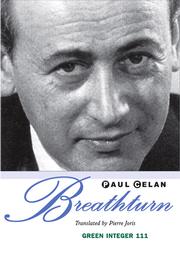
Breathturn
Paul Celan
Translated from the German
with an Introduction by Pierre Joris /
A Bilingual Edition
From Publishers Weekly
In Europe, Celan has become an increasingly important poet of the second half of the 20th century, largely for his efforts to create a post-Holocaust language for German poetry. The facts of his life seem inseparable from his work: his term in a Nazi work camp, the murder of his parents by the Nazis, his death by suicide in his adopted France in 1970. Joris, a poet and professor at SUNY-Albany, places Celan and this work (Atemwende, originally published in 1967) in context for the uninitiated American reader and discusses the problems in translating this poet's writing. Celan consciously attempted to move the German language away from lyricism toward a terse, charged accuracy that could reflect the unrepresentable: "Down melancholy's rapids/ past the blank/ woundmirror:/ there the forty/ stripped lifetrees are rafted./ Single counter-/ swimmer, you/ count them, touch them/ all." Joris's translations (on pages facing the German text) capture much of the multilingual resonance, subtlety and compressed power of Celan's brilliant, difficult work, which has absorbed the interest of such critics as George Steiner and Jacques Derrida.
Copyright 1995 Reed Business Information, Inc. --This text refers to an out of print or unavailable edition of this title.
From Library Journal
One of the greatest German-language poets of the century (born in what is now Romania), Celan has had a significant influence on poetic trends in the United States as well as in Europe. He committed suicide in 1970, having spent time in forced labor camps during the war. He has been described as surrealist because his poems use language and draw together images in ways that challenge the reader to make sense of them. "Sense" is perhaps not intended by this poet, noted for creating composite words like "eternityteeth," "desertbread," and "heartshadowcord." His poems are possessed of a positive energy that is difficult to explain, given his tragic background. Others have translated Celan into English, most notably poet Michael Hamburger (Poems of Paul Celan, LJ 5/1/89). Joris's translations, offered here in a bilingual edition, do not differ greatly from Hamburger's, both translators are competent and careful. Joris's major contribution is tackling the entirety of Atemwende (1967), bringing many previously untranslated poems to the attention of English-speaking audiences. Recommended for collections of world poetry. Judy Clarence, California
Copyright 1995 Reed Business Information, Inc. --This text refers to an out of print or unavailable edition of this title.